Will Shiba Inu Coin Reach $1? Supply & Market Cap Explained
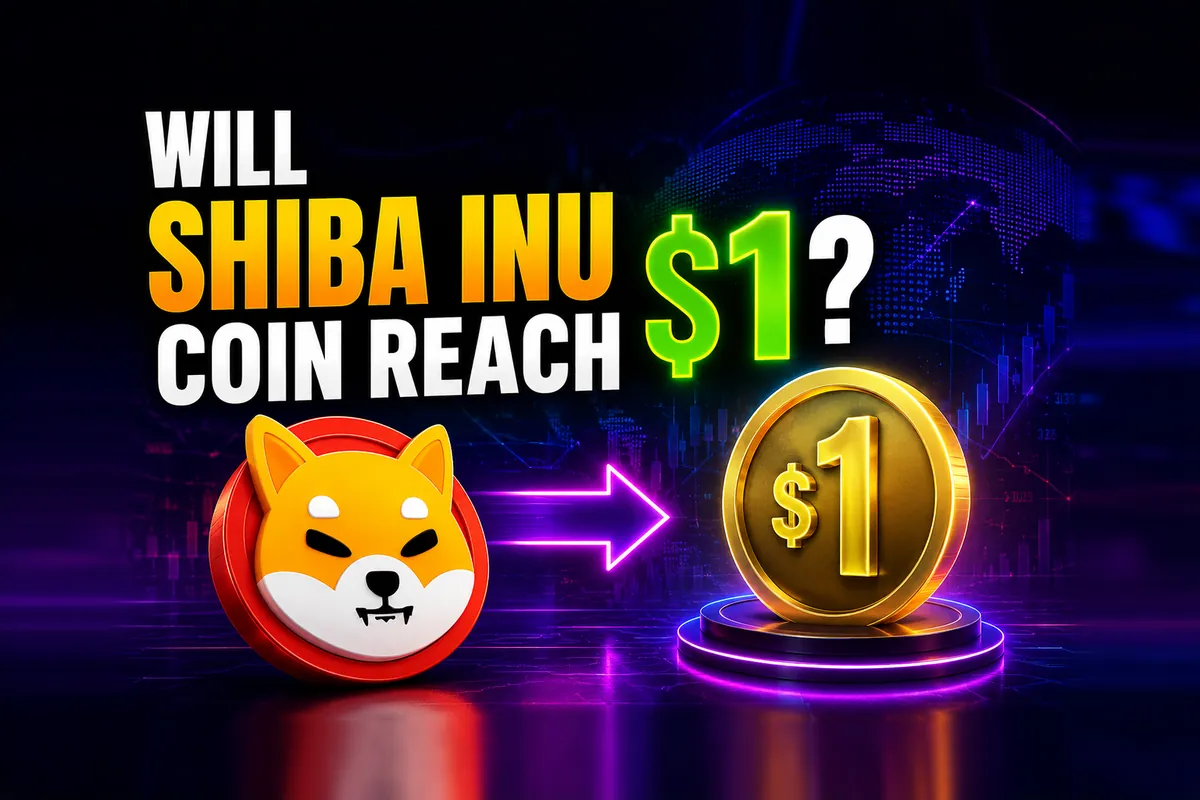
Shiba Inu’s tiny unit price makes a $1 target sound simple, but you can’t judge a token’s price without considering circulating supply. SHIB currently has roughly 589 trillion tokens in circulation, so a one-dollar price would imply a market value measured in hundreds of trillions of dollars. That is why the useful question is not just whether $1 is mathematically possible. It is whether supply could fall enough, and demand could grow enough, for such a valuation to become realistic.
At roughly the current circulating supply, Shiba Inu reaching $1 would imply a market capitalization of about $589 trillion, which makes the target highly unrealistic under present conditions. A dramatically smaller supply could change the mathematics, but burns alone would not guarantee $1 because demand, liquidity, ecosystem usage, and broader market conditions would still need to support the price.
Can Shiba Inu Really Reach $1?
A $1 SHIB price is mathematically possible in a purely hypothetical sense because the market-cap equation can produce that result if the circulating supply becomes small enough. That does not make the scenario realistic under current conditions. The key issue is scale. With hundreds of trillions of SHIB circulating, every large increase in the token price produces an enormous implied market capitalization. A future $1 price would therefore require either an extraordinary valuation at something close to today’s supply, an extreme reduction in supply, or some combination of lower supply and much stronger demand.
Why SHIB’s Circulating Supply Matters So Much
Circulating supply is the number of tokens currently counted as being in circulation. It is one of the most important numbers when evaluating a token price target because market capitalization is calculated from both price and supply. The basic formula is:
Token Price × Circulating Supply = Market Capitalization
A coin can look inexpensive because each token costs only a tiny fraction of a dollar, but that does not mean it is inexpensive in valuation terms. If the supply is extremely large, even a small increase in unit price can imply a very large total market value. SHIB’s circulating supply is currently about 589.24 trillion tokens, with CoinMarketCap reporting approximately 589.239 trillion in circulation at the time of verification.
What Would SHIB’s Market Cap Be at $1?
Using approximately 589 trillion circulating SHIB, the implied valuations look like this:
| SHIB Price | Approx. Market Cap at ~589T Supply |
| $0.0001 | $58.9 billion |
| $0.001 | $589 billion |
| $0.01 | $5.89 trillion |
| $0.10 | $58.9 trillion |
| $1.00 | $589 trillion |
These figures are valuation scenarios, not price predictions. The table shows why removing zeros from SHIB’s price becomes progressively harder in valuation terms. Moving from a tiny fraction of a cent to one cent already implies a market cap measured in trillions if supply stays close to current levels. Reaching $1 at the same supply would multiply that scale again.
A $589 trillion market cap does not mean that exact amount of cash must be deposited into SHIB. Market cap is price multiplied by circulating supply, although sustaining such a valuation would still require extraordinary demand and liquidity.
How Much SHIB Would Need to Be Burned for $1?
Token burns can permanently remove SHIB from available supply. In theory, a much smaller circulating supply would reduce the market capitalization required for a $1 price. Shiba Inu’s official ecosystem maintains burn infrastructure connected with Shibarium. Consider these hypothetical examples:
| Remaining SHIB Supply | Market Cap at $1 |
| 500 trillion | $500 trillion |
| 100 trillion | $100 trillion |
| 10 trillion | $10 trillion |
| 1 trillion | $1 trillion |
| 100 billion | $100 billion |
This table shows why burn discussions need to focus on scale rather than simply whether burns happen. Reducing supply from about 589 trillion to 100 trillion would require removing roughly 83% of the current circulating amount. Reaching 10 trillion would require a reduction of about 98.3%, while reaching 1 trillion would require removing roughly 99.83%. A fall to 100 billion would be even more extreme, requiring a reduction of around 99.98%. Those calculations explain the size of the supply change involved. They do not suggest that such reductions will occur.
Do SHIB Burns Automatically Increase the Price?
No. Burning tokens changes supply, but it does not create guaranteed demand. If fewer tokens exist while demand remains strong or increases, scarcity can affect the market. But if demand weakens, a lower supply does not automatically force the token to a particular price.
The actual scale of a burn also matters. A headline saying the burn rate increased by thousands of percent may sound dramatic, but the percentage can be misleading if the starting amount was small relative to a circulating supply measured in hundreds of trillions.
A better way to evaluate burns is to compare the number of tokens permanently removed with the total circulating supply. Long-term burn projections should also be treated cautiously. A burn rate observed over a day, week, or month cannot simply be extended for years because ecosystem activity, transaction levels, community behavior, and burn mechanisms can all change.
Demand Matters as Much as Supply
Supply is only one side of the price discussion. For a $1 SHIB price to remain meaningful, buyers would need to support that valuation in a functioning market. Relevant factors include liquidity, Spot trading activity, market sentiment, ecosystem usage, holder behavior, wider crypto adoption, and competition from other assets.
This is why an extreme burn alone would not solve the entire problem. Even if circulating supply dropped dramatically, the remaining SHIB would still need enough sustained demand for buyers and sellers to trade around the $1 level.
Market capitalization and liquidity are also different concepts. Market cap measures price multiplied by supply, while liquidity describes how easily meaningful amounts can be traded without causing large price movements. A high quoted market cap does not automatically mean a market has equally deep liquidity.
Could Shibarium Help SHIB Reach $1?
Shibarium is an Ethereum Layer 2 connected with the wider Shiba Inu ecosystem. Official Shiba Inu documentation describes it as a Layer 2 scaling solution built for interacting with and developing within the Shibarium ecosystem.
That makes Shibarium relevant to discussions about SHIB utility, ecosystem activity, and supply reduction. Greater use of the ecosystem could potentially influence transaction activity or demand. However, no direct formula says more Shibarium activity equals a $1 SHIB price. Network growth is one factor among many, and its effect on market demand cannot be guaranteed.
Can Shiba Inu Reach 1 Cent Instead?
One cent is a much smaller target than $1, but the implied valuation is still large if the supply remains near current levels. At roughly 589 trillion circulating SHIB:
- $0.001 would imply about $589 billion
- $0.01 would imply about $5.89 trillion
- $0.10 would imply about $58.9 trillion
- $1 would imply about $589 trillion
These figures are valuation scenarios, not forecasts. Each zero removed can represent a major increase in the valuation required to support the price.
What Would Have to Change for SHIB to Reach $1?
A credible $1 scenario would require conditions very different from those that exist today. First, circulating supply would likely need to fall dramatically. Keeping hundreds of trillions of tokens while reaching $1 would imply an extraordinary valuation.
Second, demand for the remaining SHIB would need to remain strong enough to support the higher price. Burns without buyers would not create the necessary market. Third, ecosystem utility would likely need substantial development. Greater usage, applications, and transaction activity could potentially support demand, although none of these guarantees a specific price.
Liquidity would also matter. A sustainable market needs enough depth for meaningful buying and selling without extreme price instability. Finally, the wider crypto market would likely need to be much larger if SHIB were to support a valuation far beyond today’s major digital assets. None of these conditions can be assumed to occur.
Why “SHIB Is Cheap” Can Be Misleading
A common mistake is comparing cryptocurrencies only by the price of one token. Imagine one token costs $10 but has a relatively small supply, while another costs $0.00001 but has hundreds of trillions of units. The second token may look cheaper, but its total market valuation can still be substantial.
This tendency is sometimes described as unit bias: people can perceive a large number of low-priced tokens as inexpensive simply because each individual unit costs very little. Whether analyzing market data or information shared through a crypto press release, a more useful evaluation looks at circulating supply, market capitalization, liquidity, utility, and demand together.
Common Mistakes When Evaluating the SHIB $1 Target
Several mistakes can distort the discussion:
- Looking only at the price per token
- Ignoring circulating supply
- Treating token burns as guaranteed price increases
- Extending short-term burn rates far into the future
- Confusing mathematical possibility with realistic probability
- Assuming ecosystem growth guarantees price appreciation
- Treating social-media targets as evidence
- Comparing cryptocurrencies only by unit price
- Ignoring market liquidity
- Treating hypothetical market caps as forecasts
The strongest analysis starts with transparent mathematics and then considers whether the market conditions needed to support that mathematics are realistic.
Frequently Asked Questions
Will Shiba Inu Coin Reach $1?
At roughly current supply levels, a $1 SHIB price would imply a market capitalization of about $589 trillion, making the target highly unrealistic under present conditions. A much smaller supply and sustained demand would be required to change that assessment.
What Market Cap Would SHIB Need to Reach $1?
With roughly 589 trillion SHIB circulating, a $1 price would imply approximately $589 trillion in market capitalization. The exact figure changes if the circulating supply changes.
How Much SHIB Would Need to Be Burned to Reach $1?
There is no single required burn amount because the answer depends on the market capitalization that could be supported in the future. Reducing supply toward 1 trillion SHIB would require eliminating roughly 99.83% of today’s circulating amount.
Can SHIB Burns Make Shiba Inu Reach $1?
Burns can reduce supply and change the valuation mathematics, but they cannot guarantee a $1 price. Demand, liquidity, market conditions, and ecosystem usage would still matter.
Can Shiba Inu Reach 1 Cent?
At the current supply, a $0.01 SHIB price would imply a market capitalization of roughly $5.89 trillion. That is a mathematical scenario rather than a prediction.
Does Shibarium Increase the Chances of SHIB Reaching $1?
Shibarium can contribute to ecosystem activity, applications, and burn mechanisms, but greater network usage does not guarantee a particular SHIB price.
Final Thoughts
Will Shiba Inu coin reach $1? Under today’s approximate circulating supply, the mathematics make that target extraordinarily difficult to justify. A $1 price would imply a valuation of roughly $589 trillion if supply stayed near current levels. Massive token burns could make the required market capitalization smaller, but supply reduction is only one part of the equation.
Demand, liquidity, ecosystem utility, market participation, and broader crypto conditions would still need to support the remaining tokens at that price. The most useful way to evaluate the $1 claim is therefore not to focus on the number alone. Start with circulating supply, calculate the implied market cap, and then ask whether the supply and demand changes required for that valuation are realistically supportable.