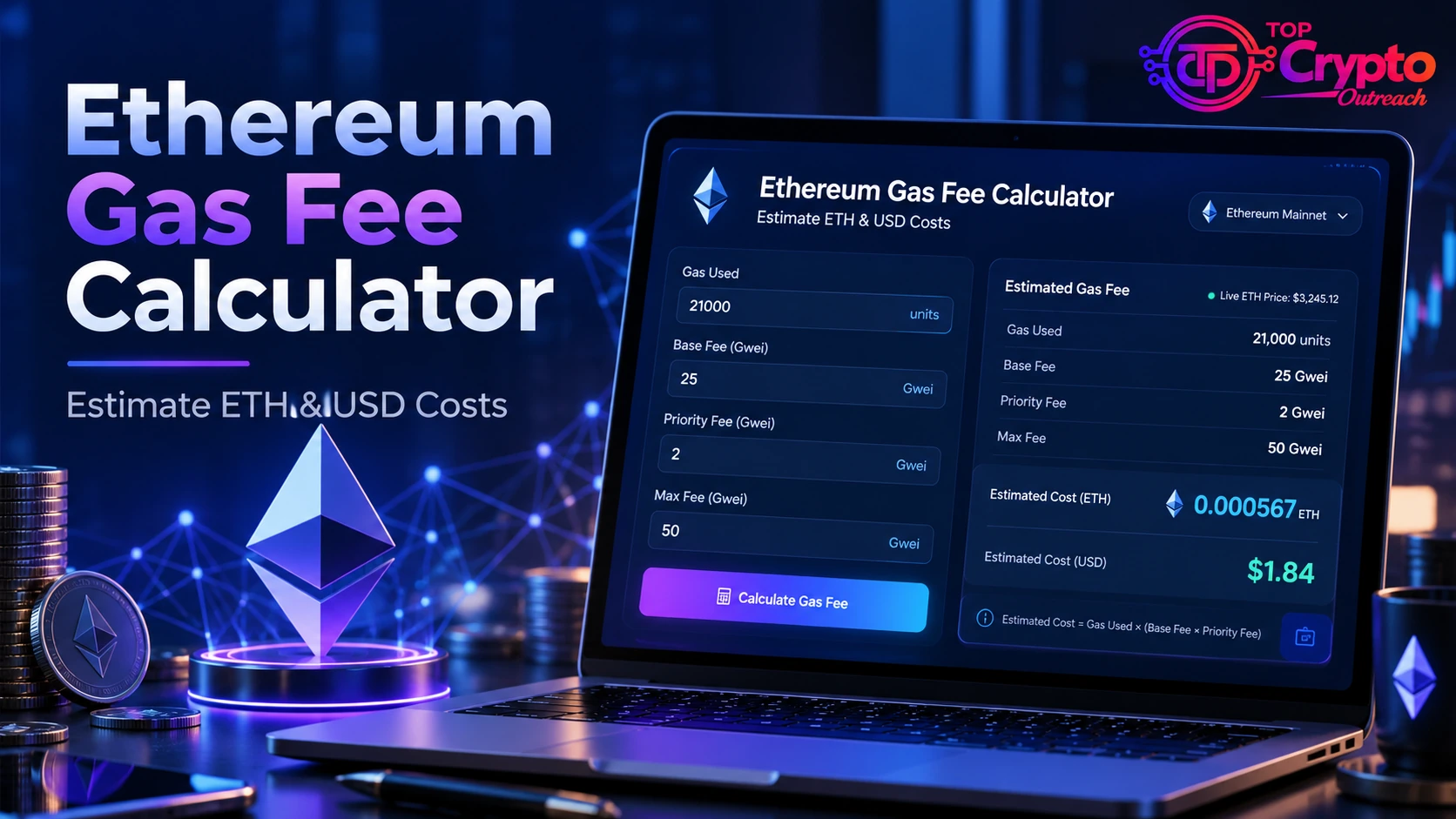
Ethereum Gas Fee Calculator: Estimate ETH Gas Costs
Every transaction on Ethereum requires a network fee, whether you are sending ETH, transferring tokens, or interacting with a smart contract. The amount depends on the computational resources used and the gas price when the transaction is processed. Our Ethereum Gas Fee Calculator helps you estimate these costs using gas units, base fees, priority fees, and optional ETH prices. It also separates expected execution costs from maximum fee allowances, making Ethereum transaction expenses easier to understand before submitting a transaction.
An Ethereum Gas Fee Calculator estimates transaction costs by multiplying gas used by the effective gas price. Under EIP-1559, this price includes a network base fee and a validator priority fee, subject to the maximum fee cap. The calculator displays estimated costs in ETH and Wei, with optional USD values.
Ethereum Gas Fee Calculator
Estimate Ethereum transaction fees from EIP-1559 inputs. Compare your likely execution cost with the maximum fee allowance, using exact Wei calculations.
Transaction setup
Gas price (Gwei)
Pre-filled fees are examples, not live network quotes. Enter rates from your wallet or explorer. Max fee is an allowance cap, not the expected fee.
Estimated cost
6300000000000021,000 gas x 3 Gwei = 0.000063 ETH
Under EIP-1559, effective gas price = base fee + min(priority fee, max fee - base fee). If no max fee is entered, the illustration uses base fee + tip. Total fee uses estimated gas consumed, not gas limit.Ethereum mainnet execution-gas estimator only. Does not estimate layer-2 data fees, blob gas, wallet/provider markups or real-time confirmation. Actual gas used and fees can differ.
How to Use the Ethereum Gas Fee Calculator
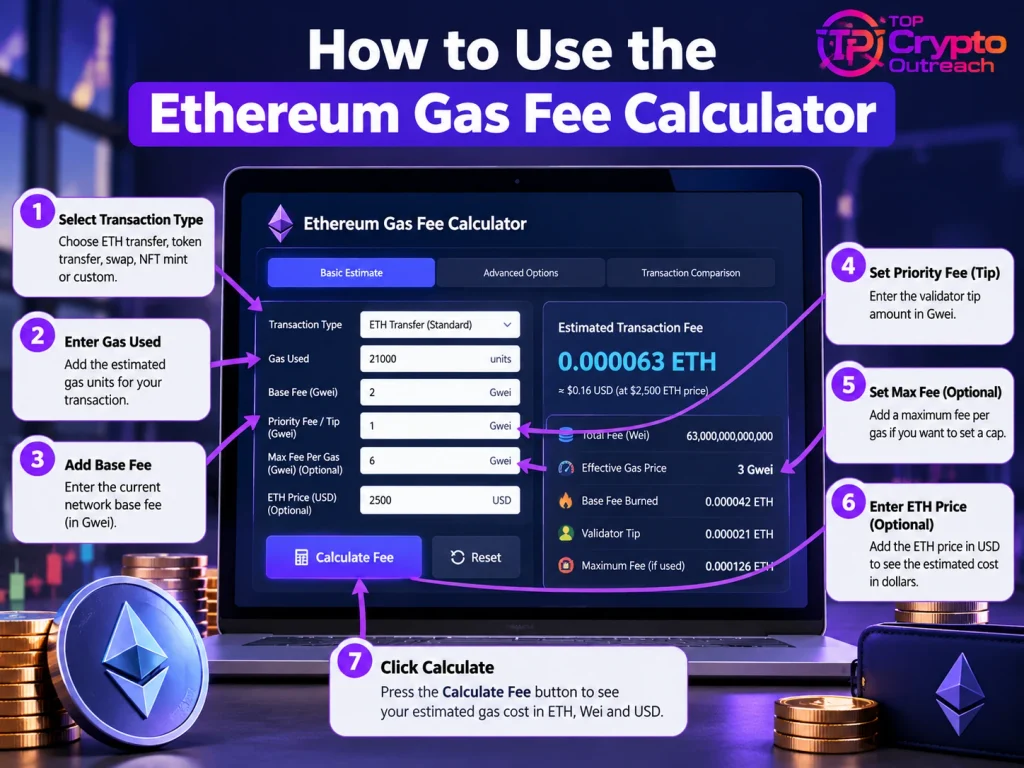
Start by selecting the transaction type you want to estimate. The calculator provides options for a standard ETH transfer, ERC-20 token transfer, token swap, NFT mint, or a custom transaction. These presets provide starting estimates rather than guaranteed gas consumption.
Next, enter the estimated gas used and gas limit. A standard ETH transfer typically requires 21,000 gas units, while smart-contract interactions can consume significantly more depending on their complexity.
Enter the base fee and priority fee in Gwei. If you have a maximum fee per gas from your wallet, you can enter that value as well. The calculator uses these inputs to determine the estimated effective gas price.
For a USD estimate, enter an ETH price manually. The tool then displays the estimated transaction cost in ETH, Wei, and USD, alongside the base fee burned, validator priority fee, and maximum fee allowance.
The calculator does not fetch live network prices, so use current fee information from your wallet or a reliable Ethereum network explorer when checking a specific transaction.
What Is an Ethereum Gas Fee?
An Ethereum gas fee is the amount paid for the computational resources required to process a transaction on the Ethereum network. Gas measures the work performed, while the gas price determines the amount of ETH paid for each unit consumed.
Every Ethereum transaction requires some gas, but the amount varies according to the operation. Sending ETH between standard accounts is relatively simple, while interacting with smart contracts can involve multiple computational steps and storage changes.
Gas fees serve an important purpose by helping allocate network resources and discouraging transaction spam. Without a cost for computation, users could repeatedly submit resource-intensive operations without bearing the associated expense.
Ethereum gas fees are paid in ETH even when the transaction involves another token. For example, transferring an ERC-20 token generally requires ETH to cover its execution fee on Ethereum mainnet.
How Ethereum Gas Fees Work Under EIP-1559
Ethereum introduced the EIP-1559 fee mechanism to make transaction pricing more structured. Instead of relying entirely on a single gas-price bid, the system uses a protocol-determined base fee and an optional priority fee.
Understanding these components is important because the maximum fee shown in a wallet is not necessarily the amount a transaction will actually cost.
Base Fee
The base fee is determined automatically by the Ethereum protocol. It adjusts according to network demand and the amount of gas used in previous blocks.
When blocks exceed their gas target, the base fee tends to increase. When usage falls below the target, it tends to decrease. This mechanism responds to congestion without requiring users to negotiate the entire fee through a traditional auction.
The base fee is burned rather than paid to a validator, meaning that portion of ETH is permanently removed from circulation.
Priority Fee
The priority fee, often called a tip, is an additional amount that can encourage validators to include a transaction.
Users can specify a priority fee, although many wallets automatically recommend an amount based on current network conditions. A higher tip may improve a transaction's attractiveness, but it does not guarantee immediate confirmation.
The priority fee actually paid can also be limited by the maximum fee per gas selected for the transaction.
Maximum Fee Per Gas
The maximum fee per gas is the highest combined base fee and priority fee a user authorizes per gas unit.
If the network base fee plus the intended priority fee is below this cap, the full cap is not charged. Instead, the transaction uses the applicable effective gas price.
If the cap is too low to cover the base fee, the transaction cannot be included under those fee conditions. This distinction prevents users from confusing a spending ceiling with an actual transaction charge.
Ethereum Gas Fee Formula and Calculation Example
For an EIP-1559 transaction, the effective gas price is calculated using the base fee, priority fee, and maximum fee cap.
Effective Gas Price = Base Fee + min(Priority Fee, Max Fee − Base Fee)
This formula applies when the maximum fee is at least equal to the base fee. When no maximum fee is specified for a simple estimate, the calculation uses the base fee plus the intended priority fee.
The transaction fee is then:
Gas Fee = Gas Used × Effective Gas Price
Consider the following example:
| Input | Example Value |
|---|---|
| Gas Used | 21,000 |
| Base Fee | 2 Gwei |
| Priority Fee | 1 Gwei |
| Maximum Fee | 6 Gwei |
| ETH Price | $2,500 |
The effective gas price is 3 Gwei because the base fee and priority fee together remain below the 6 Gwei cap.
Therefore:
21,000 × 3 Gwei = 63,000 Gwei
Since one ETH contains one billion Gwei:
Estimated Gas Fee = 0.000063 ETH
At the example ETH price of $2,500, the estimated cost is approximately $0.16.
These figures illustrate the calculation method. Actual transaction fees depend on the network conditions and gas consumption when a transaction is included in a block.
Typical Gas Usage for Ethereum Transactions
Different Ethereum operations require different amounts of gas because they perform different kinds of work.
A simple ETH transfer usually requires fewer computational resources than a transaction involving a smart contract. Token transfers, swaps, and NFT operations may involve additional contract calls, storage updates, and other execution steps.
| Transaction Type | Gas Usage |
|---|---|
| Standard ETH transfer | Typically 21,000 gas |
| ERC-20 token transfer | Varies by token contract |
| Token swap | Varies by protocol and route |
| NFT mint | Varies by contract and minting logic |
| Complex smart-contract interaction | Depends on execution requirements |
The calculator includes illustrative presets to make these differences easier to explore. However, preset values should not replace a wallet or contract-specific gas estimate when preparing a real transaction.
For smart-contract interactions, the exact gas consumed can depend on the contract implementation, current storage state, and execution path.
Gas Used vs Gas Limit: What Is the Difference?
Gas used and gas limit are related, but they represent different quantities.
Gas used measures how many gas units the transaction actually consumes during execution. Gas limit specifies the maximum amount of gas the transaction is permitted to use.
Suppose a transaction has a gas limit of 100,000 units but successfully consumes only 65,000. Its execution fee is based on the 65,000 units consumed rather than the entire limit.
The remaining 35,000 units are not charged merely because they were available.
However, setting the gas limit too low creates a different problem. If a transaction runs out of gas during execution, it may fail while still consuming gas and incurring a fee.
The Ethereum Gas Fee Calculator separates these values to help users understand the difference between estimated execution cost and maximum potential gas expenditure.
How to Convert Ethereum Gas Fees From Gwei to ETH and USD
Ethereum gas prices are commonly displayed in Gwei because the values are easier to read than small fractions of ETH.
The conversion relationship is fixed:
1 Gwei = 0.000000001 ETH
1 ETH = 1,000,000,000 Gwei
To convert a gas fee from Gwei to ETH, divide the total Gwei amount by one billion. To estimate the USD value, multiply the ETH amount by the selected ETH/USD price.
For example, a fee of 100,000 Gwei equals 0.0001 ETH. If ETH is valued at $2,500, that fee corresponds to $0.25.
The Gwei-to-ETH relationship never changes, but its USD equivalent changes with ETH's market price. Our Crypto Unit Converter also provides exact conversions between ETH, Gwei, Wei, and other blockchain denominations.
Why Do Ethereum Gas Fees Change?
Ethereum gas fees change primarily because the demand for block space is not constant. When many users submit transactions or interact with popular applications, network resources become more competitive.
Demand can increase during major token launches, NFT activity, decentralized exchange transactions, or periods of broader market volatility.
Under EIP-1559, the base fee adjusts according to block usage. Priority fees may also vary as users compete for faster inclusion.
This means that two similar transactions submitted at different times can have different fees, even when they consume the same amount of gas.
Smart-contract complexity introduces another source of variation. Two swaps may use different amounts of gas because they follow different execution paths or interact with different contracts.
For this reason, the most accurate estimate combines the expected gas usage for the intended transaction with relevant fee information for the time it will be submitted.
Understanding the Base Fee Burn and Validator Tip
Ethereum's fee structure divides the execution fee into two principal components: the base fee and the priority fee.
The base fee is burned by the protocol, while the priority fee is paid to the validator proposing the block that contains the transaction.
Using the earlier example of 21,000 gas units, a 2 Gwei base fee, and a 1 Gwei priority fee:
| Component | Amount |
|---|---|
| Base Fee Burned | 0.000042 ETH |
| Validator Priority Fee | 0.000021 ETH |
| Total Execution Fee | 0.000063 ETH |
This breakdown helps explain where the transaction fee goes. It also shows why the entire amount paid for gas is not received by the validator.
The calculator provides these figures separately so users can see how much of the estimated execution cost comes from each component.
How to Reduce Ethereum Gas Costs
Ethereum transaction costs can sometimes be reduced through better timing, appropriate network selection, and more efficient transaction execution.
Network demand changes throughout the day, so checking gas conditions before submitting a non-urgent transaction may help users avoid unusually expensive periods. However, lower fees at a particular time are never guaranteed.
Choosing an appropriate gas configuration also matters. Setting an unnecessarily high maximum fee does not automatically increase the amount charged, but selecting priority fees without understanding current conditions can lead to unnecessarily expensive transactions.
Layer-2 networks can provide lower-cost transaction options for supported activities. However, their fee structures may include additional data-related components, and users should consider network compatibility and security assumptions.
This calculator estimates Ethereum mainnet execution gas only. It does not include every fee component that may apply to layer-2 transactions or specialized Ethereum operations.
Common Ethereum Gas Fee Calculation Mistakes
A common mistake is multiplying the gas limit by the maximum fee and assuming the result will always be charged. This calculation represents a possible maximum allowance, not necessarily the actual execution cost.
Another mistake is treating a priority fee as the entire gas price. Under EIP-1559, the effective gas price includes both the applicable base fee and the priority fee, subject to the fee cap.
Users may also confuse Gwei with ETH. Since one ETH contains one billion Gwei, failing to convert the denomination correctly can create a substantial error.
Finally, transaction presets should not be treated as guaranteed gas estimates. Contract-based operations can vary, and even failed transactions may consume gas.
The safest approach is to verify the inputs, understand the fee components, and compare the estimate with the information provided by the wallet before submitting a transaction.
FAQs
How do I calculate Ethereum gas fees?
Multiply the gas units consumed by the effective gas price. Under EIP-1559, the effective price combines the base fee with the permitted priority fee, subject to the maximum fee cap. Convert the result from Gwei into ETH to find the transaction's estimated execution cost.
How much gas does a normal ETH transfer use?
A standard transfer of ETH between externally owned accounts typically uses 21,000 gas units. Transactions involving smart contracts, tokens, or additional operations can consume more gas depending on their implementation.
What is the difference between gas price and gas limit?
Gas price specifies the amount of ETH paid per gas unit, usually displayed in Gwei. Gas limit specifies the maximum gas units the transaction can consume. The final execution fee depends on the actual gas consumed and the applicable gas price.
Is the maximum gas fee always charged?
No. Under EIP-1559, the maximum fee per gas acts as a cap. If the effective gas price is below that cap, the transaction does not pay the full maximum rate merely because it was authorized.
Do failed Ethereum transactions still cost gas?
Yes. A transaction that fails during execution can still consume computational resources and incur gas fees. The amount depends on the gas used and the applicable gas price, even when the intended operation does not complete successfully.
Does this Ethereum Gas Fee Calculator show live prices?
No. The calculator uses manually entered gas fees and an optional ETH/USD price. This keeps the calculation transparent and independent of live price APIs, but users must supply current information when estimating real transactions.
Final Thoughts
The Ethereum Gas Fee Calculator helps estimate transaction execution costs by separating gas consumption, base fees, validator tips, and maximum fee allowances. Understanding these components makes it easier to interpret wallet fee estimates, avoid calculation mistakes, and assess Ethereum transaction expenses without confusing fee limits with actual charges.